
The reaction distance is the distance covered by the vehicle...
- A)From when the driver perceives danger until the vehicle stops.
- B)From when the driver presses the brake until the vehicle comes to a complete stop.
- C)From when the driver perceives the danger until initiating a manoeuvre.✓ Correct answer
Why this is the correct answer
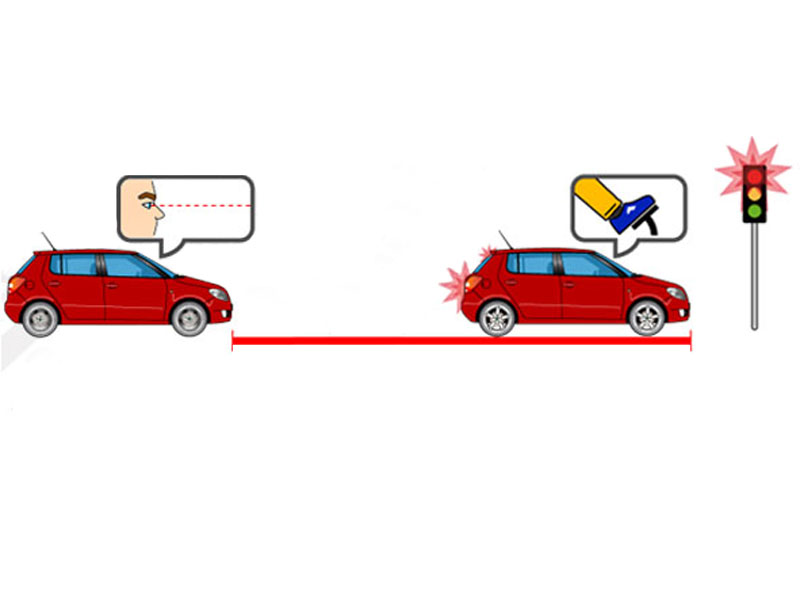
Reaction distance is the distance your vehicle travels during your reaction time, i.e., from the moment you perceive a hazard until you start to act (e.g., press the brake pedal or perform an evasive manoeuvre). As shown in the image, the left car represents the moment of perception (the driver sees the danger, illustrated by the eye icon), and the right car represents the moment the driver acts (pressing the brake, shown by the foot icon). The red line between them is the reaction distance. During this time, the vehicle continues moving at the same speed because no braking has yet occurred. Under normal conditions, a driver's reaction time is approximately 0.75 seconds. At 50 km/h this means about 10 metres; at 120 km/h, about 25 metres or more. Do not confuse it with: - Braking distance (option B): the distance from pressing the brake until the vehicle stops completely. This depends on speed, vehicle weight, tyre condition, and road surface. - Stopping distance (option A): the total distance from perceiving the hazard until the vehicle comes to a complete stop. It is the sum of reaction distance + braking distance. Factors that increase reaction time (and therefore reaction distance) include: fatigue, alcohol, drugs, medications, distractions (e.g., mobile phone use), high interior temperature, and poor visibility. The faster you drive, the greater the reaction distance will be, even if your reaction time stays the same.
More questions about driving types & techniques
- When turning left at this intersection, where should the centre of the intersection be in relation to your vehicle?
- You are driving during the day and it starts to rain torrentially, severely reducing visibility, as shown in the image. Must you turn on the rear fog lights?
- During the day, you are driving your vehicle and notice light snow, so you turn on the dipped headlights and position lights. Do you believe you have activated the correct lights?
- Which types of roads are perceived to have a higher accident risk?